Material Wallpaper Android is a source-code package for building a wallpaper and image gallery app: a native Android client paired with a PHP and MySQL admin panel. It is sold on CodeCanyon for $38 by the developer solodroid, and the current release targets Android 15. It suits developers and small studios that want a working gallery app to rebrand rather than a template to build from scratch.
The listing carries 1,771 sales and a 4.87 average from 253 reviews, which is a meaningful signal for a CodeCanyon item in this price bracket. The purchase delivers the Android project files, the server-side PHP code and documentation, so the buyer receives both halves of a two-part system.
What Material Wallpaper Android actually includes
The product is split cleanly into a client and a server. The Android side is a Java project supplied as .java and .xml files, opened in Android Studio; there is no Kotlin in the package. The server side is PHP with a MySQL database, and it drives everything the app displays. That split matters because it determines what skills a buyer needs: Android build tooling for the app, and ordinary web hosting with a database for the backend.
The admin panel is the operational core. From a browser, an administrator creates categories, uploads images, and controls the settings the app reads at launch. Because content is delivered from the server rather than bundled into the APK, wallpapers can be added or removed without shipping a new version to Google Play. That is the single biggest practical advantage of this architecture over a static gallery template.
Wallpaper delivery, live wallpaper and scheduled rotation
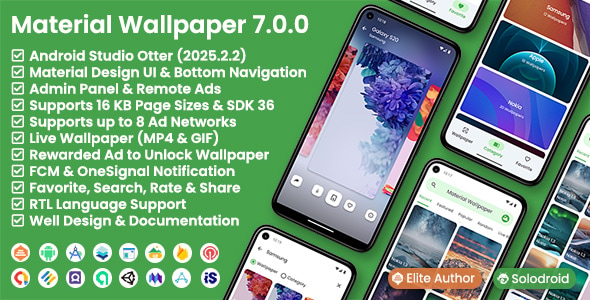
The app handles static images and MP4 live wallpapers, with preview playback handled by Media3 ExoPlayer. A recent release added an automatic wallpaper change feature, which rotates the device wallpaper on a schedule rather than requiring the user to pick a new one each time. Version 6.6.0 also strips audio from MP4 live wallpapers automatically when they are applied, a small detail that avoids an obvious user complaint.
Monetisation and push notifications
Advertising is built in rather than bolted on. The package ships with several ad SDK variants covering AdMob, AppLovin, Unity and others, including a no-ads build for buyers who want a clean app. Formats include native ads, banner placements and rewarded video, and the rewarded format is tied to a lock feature: a wallpaper can be marked as locked and unlocked by watching a video. Push notifications run through Firebase Cloud Messaging and OneSignal, so an operator can announce new collections without an app update.
Discovery features inside the app
Search with saved history, category tabs, download counts and multiple sort orders give the app the browsing behaviour users expect from a gallery. A blur-on-swipe effect in the detail view is cosmetic but reads as considered. Wallpaper ordering can be set to most-downloaded or oldest, which lets an operator surface popular content without manual curation.
Where Material Wallpaper Android fits, and where it does not
The clearest fit is a publisher or small studio that already runs a website and wants a companion app for its wallpaper library. The PHP admin panel means content management happens on infrastructure the buyer already understands, and the Android project can be rebranded with a new package name, app icon and colour scheme before release.
It also suits a freelancer delivering a fixed-scope app for a client who wants a wallpaper product without commissioning one from zero. The build is already assembled, the ad integrations exist, and the documentation covers setup with screenshots. The time saved is the entire point of buying a code package.
The wrong choice is a buyer with no Android Studio experience and no appetite for it. This is a source-code product, not a hosted service: opening the project, changing the package name, generating a signed release build and publishing to Google Play are all the buyer’s responsibility. Similarly, anyone wanting a no-code app builder or a JavaScript-based cross-platform project should look elsewhere, because this is a Java and PHP stack with a real server to maintain.
A third mismatch is a project that needs a wallpaper app with no backend at all. If content will be bundled or pulled from a third-party API, the PHP admin panel becomes dead weight and the value proposition weakens considerably.
Strengths and limitations of the package
Strengths
- Complete two-sided system. The buyer gets the Android client and the PHP admin panel, not just one half, which removes the most common integration headache in this category.
- Sustained maintenance. The changelog shows regular releases tracking Android Studio versions and Gradle plugin updates, with the most recent dated February 2026. That cadence is the main defence against a package going stale.
- Broad ad network support. Multiple SDK variants and formats mean monetisation can be configured without writing ad code, and a no-ads build exists for paid or ad-free deployments.
- Strong buyer feedback. A 4.87 rating across 253 reviews and 1,771 sales indicates the package works as described for most purchasers.
- Recent reliability fixes. Version 7.0.0 specifically addresses save, share and apply failures after app data reset, and improves wallpaper setting on Oppo, Vivo, Xiaomi and Huawei devices by using the system picker.
Limitations
- Java, not Kotlin. The Android source is Java. Teams that have standardised on Kotlin will either maintain a Java codebase or port it, and neither is free.
- Demo images are not included. The vendor states plainly that the preview images are excluded from the download, so a new buyer starts with an empty gallery and must source content before the app looks presentable.
- Server maintenance is on the buyer. The PHP and MySQL backend needs hosting, updates and security attention. The vendor does not state any managed hosting option.
- Price rose on the marketplace. The vendor notes the Envato price moved from $14 to $38 after a marketplace fee change, and now promotes buying directly. Buyers should compare the two routes, including what support and licensing each includes, rather than assuming they are identical.
- Design is opinionated. The app follows a Material-style layout. Buyers wanting a distinctly different visual identity face more rework than a colour swap.
How Material Wallpaper Android compares with the wider category
Wallpaper app source code on marketplaces generally falls into three groups: Android-only templates with content bundled locally, cross-platform projects built on web technologies, and full client-server systems like this one. The first group is cheaper and simpler to launch but cannot update content without an app release. The second reaches more platforms but often feels less native and can struggle with live wallpapers and system wallpaper APIs.
Against the client-server group, the differentiator here is maturity rather than novelty. The changelog shows years of incremental fixes to real problems, including the awkward device-specific behaviour of Chinese Android manufacturers and Play Store warnings about outdated SDKs. A newer competitor may look fresher but has not accumulated those fixes.
The trade-off is that a full backend brings operational weight. A buyer comparing options should weigh whether server-managed content is genuinely needed. If it is, this package competes well on completeness and price. If it is not, a simpler template will cost less in time and hosting.
Frequently Asked Questions
What programming languages does Material Wallpaper Android use?
The Android app is written in Java with XML layouts, and the admin panel and API are written in PHP backed by a MySQL database. There is no Kotlin in the package. Buyers need Android Studio to build the client and standard web hosting with PHP and MySQL to run the server side.
Can the app content be updated without publishing a new version?
Yes. Wallpapers, categories and most app settings are stored on the server and managed through the admin panel, so they can change without a new build reaching Google Play. Only changes to the app’s code, design or bundled configuration require a fresh release through the store.
Does Material Wallpaper Android support ads and push notifications?
Yes to both. The package includes ad SDK variants for AdMob, AppLovin, Unity and others, with banner, native and rewarded video formats, plus a no-ads build. Push notifications run through Firebase Cloud Messaging and OneSignal, allowing operators to announce new wallpaper collections to installed users.
Is a license included for publishing on Google Play?
The CodeCanyon listing grants a standard license for a single end product, but the vendor does not state Play Store publishing assistance. The buyer handles the developer account, signing keys, store listing and review process. A separate developer license is offered for unlimited projects when buying directly.
Verdict on Material Wallpaper Android
Buy Material Wallpaper Android if the goal is a server-managed wallpaper app and the team can handle a Java Android project plus a PHP backend. The combination of a complete admin panel, broad ad support and a changelog that is still being updated in 2026 makes it a sensible starting point at $38, and the sales and rating figures back that up.
Do not buy it if nobody on the project can open Android Studio, or if the plan is a no-code launch. It is also a poor fit where content will not live on a server, since the PHP side would go unused. Buyers should also confirm the licensing terms on whichever storefront they choose before committing.